Delivery layer
Atraxis™: membrane-interactive delivery.
The delivery architecture designed to place NeoTag™ signals onto the tumor membrane, without editing the genome or using viral vectors.
Delivery built on membrane fusion.
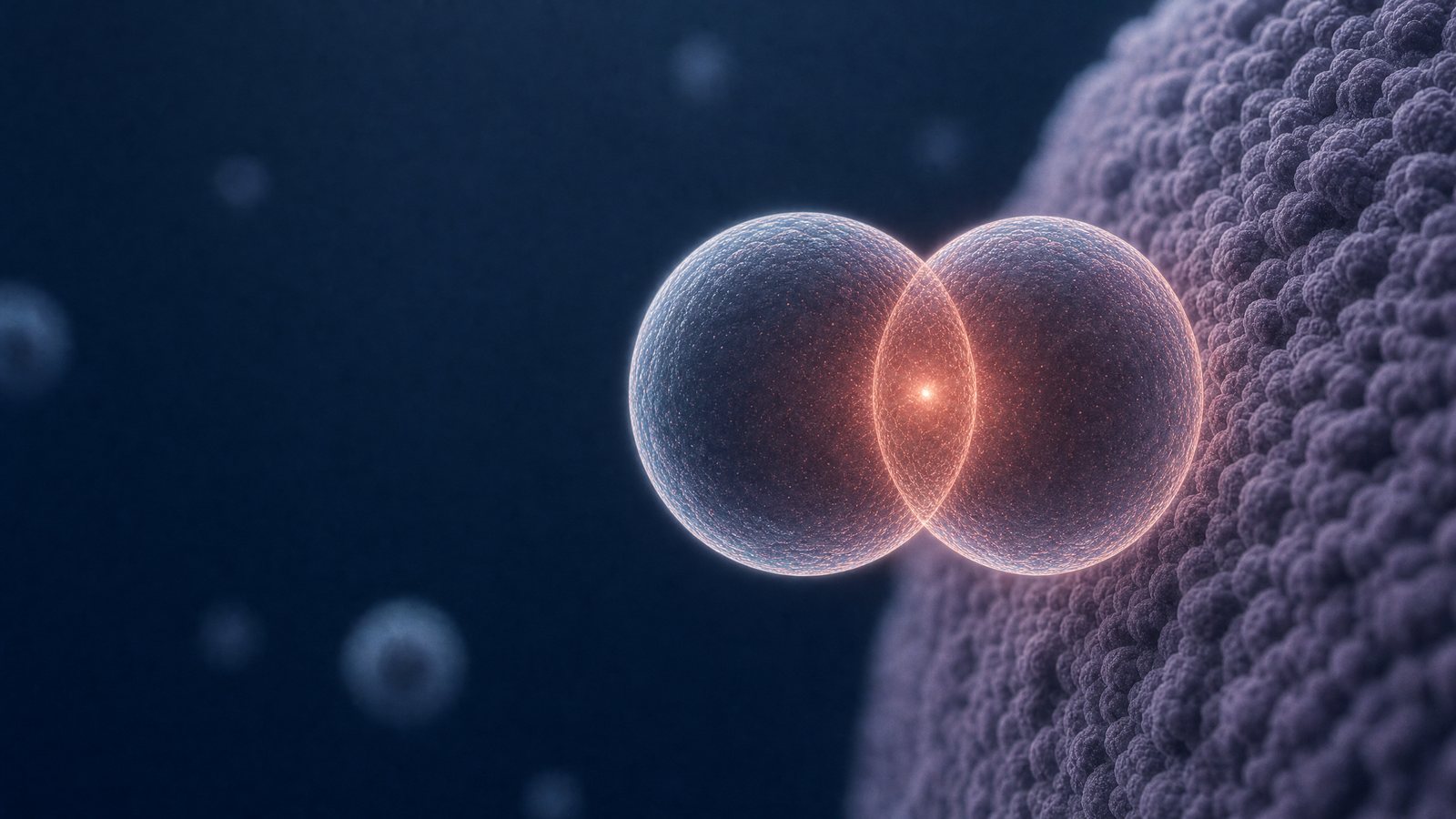
Atraxis™ is built around vesicle-mediated membrane fusion, an established biological mechanism. A carrier vesicle is designed to merge with the tumor cell’s outer membrane and deposit the signal at the surface. Its adaptive capabilities are designed to add logic-gated, selective fusion and payload co-delivery.
Vesicle-mediated membrane fusion
Non-genetic and non-viral
Controlled surface editing
Adaptive, logic-gated selectivity
Established mechanism
Built on vesicle-mediated membrane fusion, a known biological process.
Clean by design
No genome editing and no viral vectors.
Controlled editing
Designed for stable, controlled, and potentially reversible surface editing.
Selective fusion
Logic-gated, context-dependent activation rather than constant delivery.
Payload co-delivery
Designed to co-deliver payloads to support combination strategies.
Orientation control
Orientation-controlled display for spatial and temporal selectivity.
What to know about
Atraxis™
Where it fits
Atraxis™ is the delivery layer, carrying NeoTag™ signals to the tumor surface under the governance of AegisCore™ and StratIQ™.
Current status
Core filings complete. Efficient, selective fusion is a primary objective of our preclinical work.
An important note
LurexBio is a preclinical-stage company. Platform descriptions reflect design intentions and scientific hypotheses, not demonstrated results.
Delivery layer · 2 of 4
How Atraxis™ works
Part of one operating system
- 01Carriers in transit
- 02Docking
- 03Fusion
- 04Deposition
- 05Selective fusion
Step 01
Carriers in transit
Lipid vesicles carry their cargo toward the tumor.
Step 02
Docking
A vesicle meets the tumor membrane, and the two surfaces press together at the point of contact.
Step 03
Fusion
The vesicle is designed to merge with the tumor membrane through vesicle-mediated membrane fusion.
Step 04
Deposition
Once fused, the cargo is placed on the tumor surface, leaving new surface markers in position.
Step 05
Selective fusion
Adaptive precision control is designed to favor fusion with tumor cells while leaving healthy cells alone.
Illustrations are conceptual.
Explore the other layers
NeoTag™
Designed to install a recognizable immune marker on the tumor cell surface.
AegisCore™
Programmable safety and activation logic that governs when, where, and how the platform acts.
StratIQ™
The governing decision framework that coordinates every layer as one system.