Signal layer
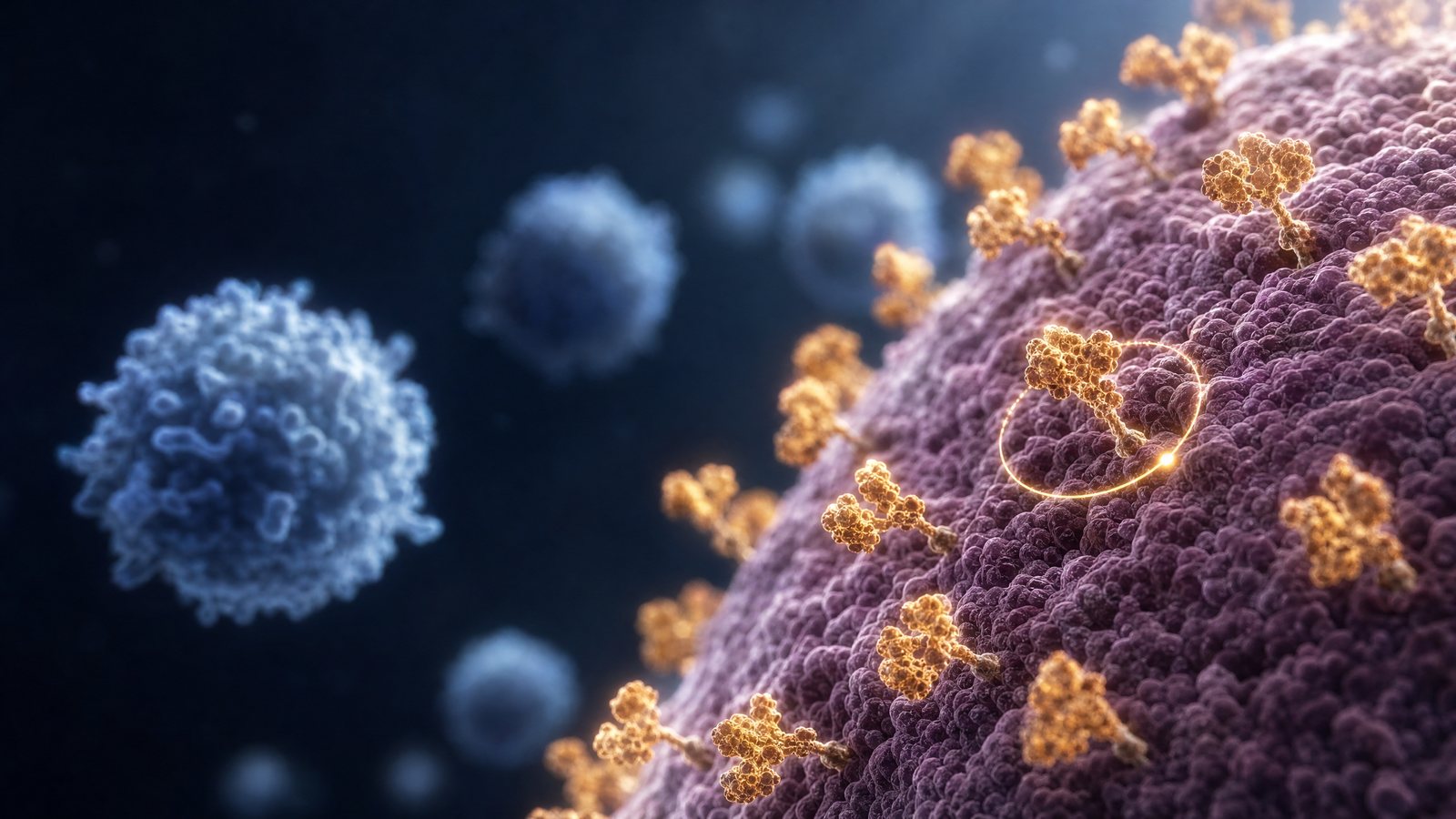
NeoTag™: immune signal installation.
Designed to install recognizable immune markers directly onto the tumor cell surface, so an immune-silent tumor can become a recognizable target.
Borrowing recognition the immune system already has.
NeoTag™ is designed to introduce engineered immune identifiers, drawn from pathogen-derived epitopes the immune system already has durable memory for, onto tumor cells. The goal is a recognizable target without building a new immune response from scratch.
Borrows an existing immune response
Surface-level only, with no genetic change
No viral vectors
Engineered for stable presentation
Recognizable by design
Built on signals the immune system already knows how to recognize.
Surface-level installation
Acts at the tumor cell surface, with no edits to the genome.
Stable presentation
Engineered for presentation at the right density and orientation.
Existing immune pathways
Designed to be read by existing T-cell and NK-cell pathways.
Combination-ready
Intended to complement current and future immunotherapies.
Modular
Designed to work with Atraxis™ delivery variants.
What to know about
NeoTag™
Where it fits
NeoTag™ is the signal layer. Atraxis™ delivers it, AegisCore™ governs when and where it acts, and StratIQ™ coordinates the system.
Current status
Provisional patent applications filed. Surface-display feasibility is a primary objective of our preclinical work.
An important note
LurexBio is a preclinical-stage company. Platform descriptions reflect design intentions and scientific hypotheses, not demonstrated results.
Signal layer · 1 of 4
How NeoTag™ works
Part of one operating system
- 01Invisible
- 02Arrival
- 03Installation
- 04Recognition
- 05Engagement
Step 01
Invisible
Many solid tumors display few signals the immune system can recognize. T cells pass by without engaging.
Step 02
Arrival
NeoTag markers travel to the tumor surface inside non-viral carriers.
Step 03
Installation
The markers are designed to anchor in the tumor cell membrane, presenting a recognizable signal without editing the tumor genome.
Step 04
Recognition
T cells are designed to recognize the installed marker, a signal the immune system already knows how to read.
Step 05
Engagement
Recognition is intended to draw more immune cells to the tumor, so a target that was hidden becomes visible.
Illustrations are conceptual.
Explore the other layers
Atraxis™
Vesicle-mediated membrane fusion designed to deliver the signal to the tumor surface.
AegisCore™
Programmable safety and activation logic that governs when, where, and how the platform acts.
StratIQ™
The governing decision framework that coordinates every layer as one system.